AdBrite

Your Ad Here

Tuesday, January 27, 2009

AT&T Takes TV Mobile With Samsung Eternity
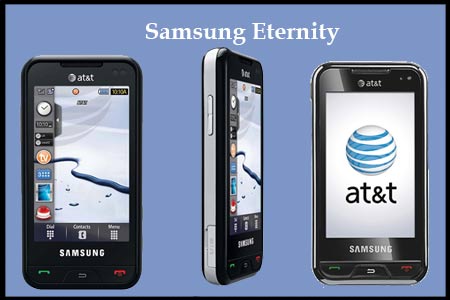
AT&T Takes TV Mobile With Samsung Eternity


AT&T Takes TV Mobile With Samsung Eternity

AT&T is looking to put TV in the palms of users' hands with its latest device, the Samsung Eternity.

The Eternity is a 3G touch-screen phone, with support for AT&T Mobile TV, while also tying in a host of other multimedia features. Along with one-touch access to Mobile TV, the device offers a full-touch QWERTY keypad, access to the mobile Web, GPS, AT&T Navigator, AT&T Mobile Music with Napster Mobile and a 3 megapixel camera.

The handheld comes in black and chrome and features a 3.2-inch touch screen. The Eternity also features haptic support, which offers subtle vibrations to confirm a user's selections while using the touch screen. Three dedicated keys on the lower portion of the device offer navigation short cuts. The Eternity also supports an accelerometer that can automatically detect motion and the orientation of the device allowing for display auto-rotation and the use of motion sensing games and photo scrolling by tilting the device.

The device centers around Samsung's TouchWiz interface, which offers specially designed widgets to customize and personalize the phone. The drag and drop feature lets users have instant access to functions like a clock, music player, instant messaging, photos and Mobile TV by adding it to their home screens.

Other key functions of the Samsung Eternity include the 3 megapixel camera with video capture; Video Share calling; messaging capabilities, including mobile email and instant messaging from Yahoo, Windows Life, AOL and more; Bluetooth; and a microSD memory card slot that can support up to 8 GB of memory.

The Web browser enables navigation with the touch of a finger and supports zoom-in and zoom-out. The device also includes dual-band 3G connectivity and quad-band GSM technology for high-speed data on the go.

AT&T Mobile TV is a service from MediaFLO USA, a wholly owned subsidiary of Qualcomm Inc. It gives users access to streaming television and sporting events from networks including CBS Mobile, CNBC, Comedy Central, ESPN Mobile TV, Fox News, Fox Mobile, NBC 2Go, MSNBC, MTV, Nickelodeon, CNN Mobile and PIX.

AT&T said the Samsung Eternity is available through AT&T retailers and AT&T Wireless' online store for $149.99 after a $50 mail in rebate with a two-year contract. Along with debuting the device, AT&T said it will offer a 30-day free trial for new AT&T Mobile TV subscribers.

IT Center For Science Upgrades Cray Supercomputer

IT Center For Science Upgrades Cray Supercomputer

Finnish IT Center For Science Upgrades Cray Supercomputer To One Of Europe’s Most Powerful

ScienceDaily (Nov. 13, 2008) — Cray Inc. and CSC - IT Center for Science Ltd has announced that CSC's Cray supercomputer has been upgraded to over 85 teraflops (trillions of floating point operations per second). This makes the new Cray XT5 system at CSC the most powerful academic supercomputer in the Nordic countries and one of the fastest supercomputers in Europe.
Later this year, a second upgrade funded under the EU's Partnership for Advanced Computing in Europe (PRACE) initiative will boost the Cray system's peak performance to 100 teraflops. PRACE, which already includes 16 nations, enables European scientists and engineers to access world-class high performance computing resources. The 100-teraflops Cray supercomputer will take one-thousandth of a second to solve a problem that ESKO, the first Finnish academic computer, would have taken 50 years to solve a half century ago.

Nordic researchers will use the supercomputer to solve scientific and engineering problems in a wide range of fields including turbulence and climate change, energy research, materials science, and gene interactions and medical research.

“The first upgrade of the Cray supercomputer ensures that Finnish researchers and engineers will continue to have access to world-class computing resources. The second, PRACE upgrade confirms CSC’s strong position and influence in building European co-operation,” said Kimmo Koski, managing director of CSC. “This powerful resource strengthens Finland's position as an attractive environment for world-class research.”

“We are delighted that CSC Finland's user community and PRACE users will have access to Cray's newest supercomputer technology,” said Ulla Thiel, vice president of Cray Europe. “As one of the most prominent supercomputing centers in Europe with a broad range of computational scientific disciplines, CSC is in an excellent position to maximize the advantages of our system in doing large scale capability computing in a production supercomputer environment and in solving the most demanding scientific problems.”

3D computer graphics software

3D computer graphics software refers to programs used to create 3D computer-generated imagery. There are typically many stages in the "pipeline" that studios use to create 3D objects for film and games, and this article only covers some of the software used. Note that most of the 3D packages have a very plugin-oriented architecture, and high-end plugins costing tens or hundreds of thousands of dollars are often used by studios. Larger studios usually create enormous amounts of proprietary software to run alongside these programs

Features
Many 3D modelers are general-purpose and can be used to produce models of various real-world entities, from plants to automobiles to people. Some are specially designed to model certain objects, such as chemical compounds or internal organs.

3D modelers allow users to create and alter models via their 3D mesh. Users can add, subtract, stretch and otherwise change the mesh to their desire. Models can be viewed from a variety of angles, usually simultaneously. Models can be rotated and the view can be zoomed in and out.

3D modelers can export their models to files, which can then be imported into other applications. Many modelers allow importers and exporters to be plugged-in, so they can read and write data in the native formats of other applications.

Most 3D modelers contain a number of related features, such as ray tracers and other rendering alternatives and texture mapping facilities. Some also contain features that support or allow animation of models. Some may be able to generate full-motion video of a series of rendered scenes

Computer software

Computer software, or just software is a general term used to describe a collection of computer programs, procedures and documentation that perform some tasks on a computer system.[1] The term includes application software such as word processors which perform productive tasks for users, system software such as operating systems, which interface with hardware to provide the necessary services for application software, and middleware which controls and co-ordinates distributed systems. Software includes websites, programs, video games etc. that are coded by programming languages like C, C++, etc.

"Software" is sometimes used in a broader context to mean anything which is not hardware but which is used with hardware, such as film, tapes and records
Overview
Computer software is usually regarded as anything but hardware, meaning that the "hard" are the parts that are tangible (able to hold) while the "soft" part is the intangible objects inside the computer. Software encompasses an extremely wide array of products and technologies developed using different techniques like programming languages, scripting languages etc. The types of software include web pages developed by technologies like HTML, PHP, Perl, JSP, ASP.NET, XML, and desktop applications like Microsoft Word, OpenOffice developed by technologies like C, C++, Java, C#, etc. Software usually runs on an underlying operating system (which is a software also) like Microsoft Windows, Linux (running GNOME and KDE), Sun Solaris etc. Software also includes video games like the Super Mario, Grand Theft Auto for personal computers or video game consoles. These games can be created using CGI (computer generated imagery) that can be designed by applications like Maya, 3ds Max etc.

Also a software usually runs on a software platform which can either be provided by the Operating System or by OS independent platforms like Java and .NET. Software written for one platform is usually unable to run on other platforms so that for instance, Microsoft Windows software will not be able to run on Mac OS because of the differences relating to the platforms and their own standards. These applications can work using software porting, interpreters or re-writing the source code for that platform